
Introduction
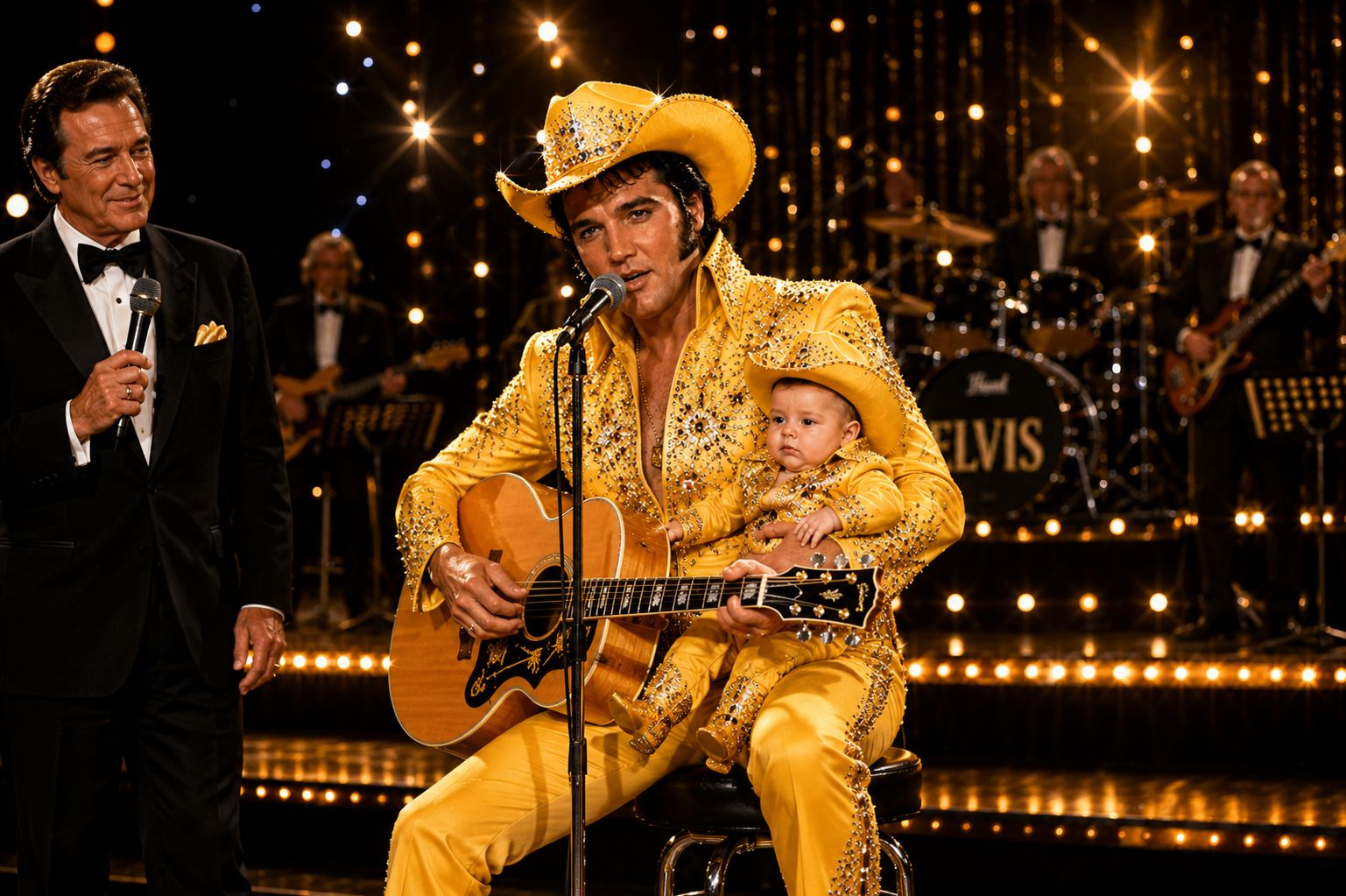
In 1957, he truly looked like a god. Breathtakingly handsome—almost indecent. In a $10,000 gold suit, his angular face, deep-set eyes, slicked-back pompadour hair, a lock of curl falling across his forehead, the corners of his mouth upturned, an air of arrogance and delight.
The suit was made by Nudie’s Rodeo Tailors in Hollywood at the request of Elvis’s manager, Colonel Tom Parker, who wanted a gold suit for his “golden boy”—“boy,” in the possessive sense Colonel Parker used to refer to his manager, gold being the currency Elvis was creating, especially for Colonel Parker, at the height of his fame.
The “$10,000” price tag, like almost everything related to Colonel Parker, was an exaggeration, a show of ostentation; the actual bill was only $2,500. Elvis first wore that suit for a performance at the Chicago International Theatre in March 1957. Within just three years, he had eight chart-topping hits, including “Heartbreak Hotel,” “Hound Dog,” “Love Me Tender,” and “All Shook Up.” At 22 years old, he was already the brightest star in American music and on the verge of becoming the world’s most famous singer. Twenty years later, he passed away.
Elvis was America writ large, in all its greatness and tawdriness, its promise and its disappointments, its fractured history and its promise of redemption. “The pure products of America go crazy,” wrote the poet and writer William Carlos Williams, and none went crazier than Elvis, his heart giving out on 16th August 1977 as he sat on his lavatory in his Graceland mansion, bloated and broken and bemused by the ingestion of some 10,000 pills in the last year of his life. He was 42.
Medical examiners found that he had traces of 14 drugs in his system at the time of his death, 10 of which were present in significant quantities, including codeine, morphine, diazepam, pentobarbital and ethinamate — drugs most commonly prescribed for anxiety and insomnia.
In a way, it’s easy to believe that Elvis now is bigger than he ever was when he was alive. He has become a myth. A morality tale. His music is lodged forever in the collective memory. His films are playing on an endless loop somewhere on TV
His life has been dissected, pored over, analysed and referenced countless times in books and articles, such as this one, studied in university courses, endlessly memorialised in films, as souvenirs and in the caricatures of Elvis impersonators. Along with those two other defining figures of his generation, Marilyn Monroe and James Dean — the tragic American trilogy — his image is iconic.
In 2008, an Andy Warhol silk-screen, Eight Elvises, was sold by the Italian art collector Annibale Berlingieri in a private sale for $100m to an unidentified buyer, thought to be the Qatari royal family. In 2014, another Warhol painting, Triple Elvis, sold for nearly $82m at an auction at Christie’s in New York. In the years since his death, the character of Elvis has featured in some 31 feature films, played by actors including Kurt Russell, Harvey Keitel and Don Johnson. According to the film critic John Beifuss, since 1957 there has been a minimum of 400 movies that contain some allusion to Elvis, 18 a year since 1998. In June, the Australian director Baz Luhrmann, of Moulin Rouge! and The Great Gatsby notoriety, will add to the list with a new film, starring Tom Hanks as the Colonel and a newcomer, Austin Butler, as Elvis.
the appeal to film-makers like Luhrmann is not difficult to understand: Elvis is estimated to be the best-selling solo music artist of all time, with sales of more than 500m records. Only the Beatles, with 600m, have sold more. Since his death, he has had 48 top-50 hits in the UK, including five number ones. You hear his records everywhere, on the radio, in adverts. Recently, walking out of the Francis Bacon exhibition at London’s Royal Academy, I was struck to hear “Suspicious Minds” being played in the gift shop as people browsed the postcards, posters and catalogues illustrated with Bacon’s hellish studies of the bestiality of man. The song sounded like a memento mori. All of us will eventually slip this mortal coil, but the greatest of us may attain a kind of immortality.