
Introduction
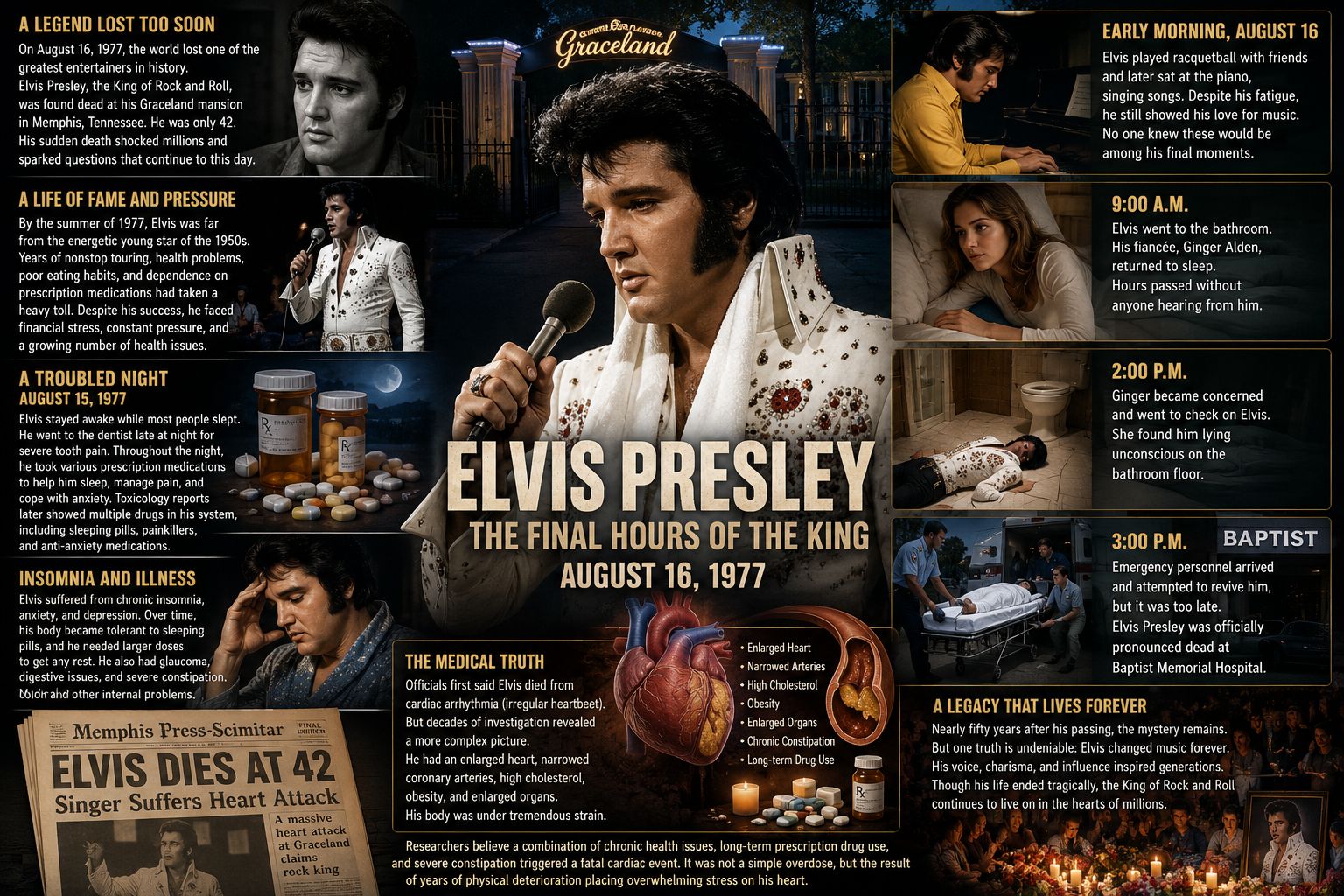
On August 16, 1977, the world lost one of the greatest entertainers in history. Elvis Presley, known around the globe as the King of Rock and Roll, was found dead at his Graceland mansion in Memphis, Tennessee. He was only 42 years old. His sudden death shocked millions of fans and immediately sparked questions about what had really happened during the final hours of his life.
By the summer of 1977, Elvis was no longer the energetic young performer who had changed popular music forever. Years of nonstop touring, health problems, poor eating habits, and dependence on prescription medications had taken a heavy toll on his body. Although he continued to perform for thousands of fans, his physical condition was deteriorating rapidly.
Despite his enormous success, Elvis was under tremendous pressure. He supported a large entourage, maintained the famous Graceland estate, and continued touring to generate income. At the same time, he struggled with chronic insomnia, anxiety, and depression. According to medical reports, he relied heavily on prescription medications to help him sleep, manage pain, and cope with emotional stress.
During the night of August 15, Elvis followed his usual nocturnal routine. He stayed awake while most people slept. Suffering from severe tooth pain, he visited a dentist late that evening. Throughout the night, he reportedly took various medications prescribed by doctors. Toxicology reports later revealed the presence of multiple prescription drugs in his system, including sleeping pills, painkillers, and medications used to treat anxiety and depression.
One of Elvis’s biggest struggles was insomnia. Friends and family recalled how difficult it was for him to sleep. Over time, his body developed a tolerance to sleeping pills, forcing him to take increasingly larger amounts to achieve the same effect. Yet even with medication, sleep often remained elusive.
In addition to sleep problems, Elvis suffered from several painful medical conditions. Reports suggested he was experiencing glaucoma, a serious eye disease that can cause intense pain. He was also dealing with chronic digestive issues and severe constipation. Medical examinations later revealed that his colon was abnormally enlarged, a condition that caused significant discomfort and may have contributed to his final medical crisis.
During the early morning hours of August 16, Elvis attempted to relax by playing racquetball with friends. Later, he sat at the piano and sang songs for those around him. Few people realized that these would be among the final songs he would ever perform. Despite appearing tired, he still displayed the musical passion that had made him a legend.
Around 9:00 a.m., Elvis went to the bathroom while his fiancée, Ginger Alden, returned to sleep. Hours passed without anyone hearing from him. At approximately 2:00 p.m., Ginger became concerned and went to check on him. She discovered Elvis lying unconscious on the bathroom floor.
Emergency personnel were immediately called, and desperate attempts were made to revive him. However, it quickly became apparent that he had been dead for some time before he was found. At 3:00 p.m., Elvis Presley was officially pronounced dead at Baptist Memorial Hospital.
Initially, officials announced that Elvis had died from cardiac arrhythmia, an irregular heartbeat. However, decades of investigation have revealed a far more complex picture. Medical experts later discovered that Elvis suffered from numerous serious health problems, including an enlarged heart, narrowed coronary arteries, high cholesterol, obesity, and enlarged internal organs. His body was under tremendous strain.
Many researchers now believe that a combination of chronic health issues, long-term prescription drug use, and severe constipation triggered a fatal cardiac event. While prescription medications may have contributed to his declining health, evidence suggests that his death was not caused by a simple overdose. Instead, it was likely the result of years of physical deterioration placing overwhelming stress on his heart.
Nearly fifty years after his passing, the mystery surrounding Elvis Presley’s death continues to fascinate fans and historians. Yet beyond the medical debates, one fact remains undeniable: Elvis changed music forever. His voice, charisma, and influence transformed popular culture and inspired generations of artists. Though his life ended tragically, the legacy of the King of Rock and Roll continues to live on around the world.