
Introduction
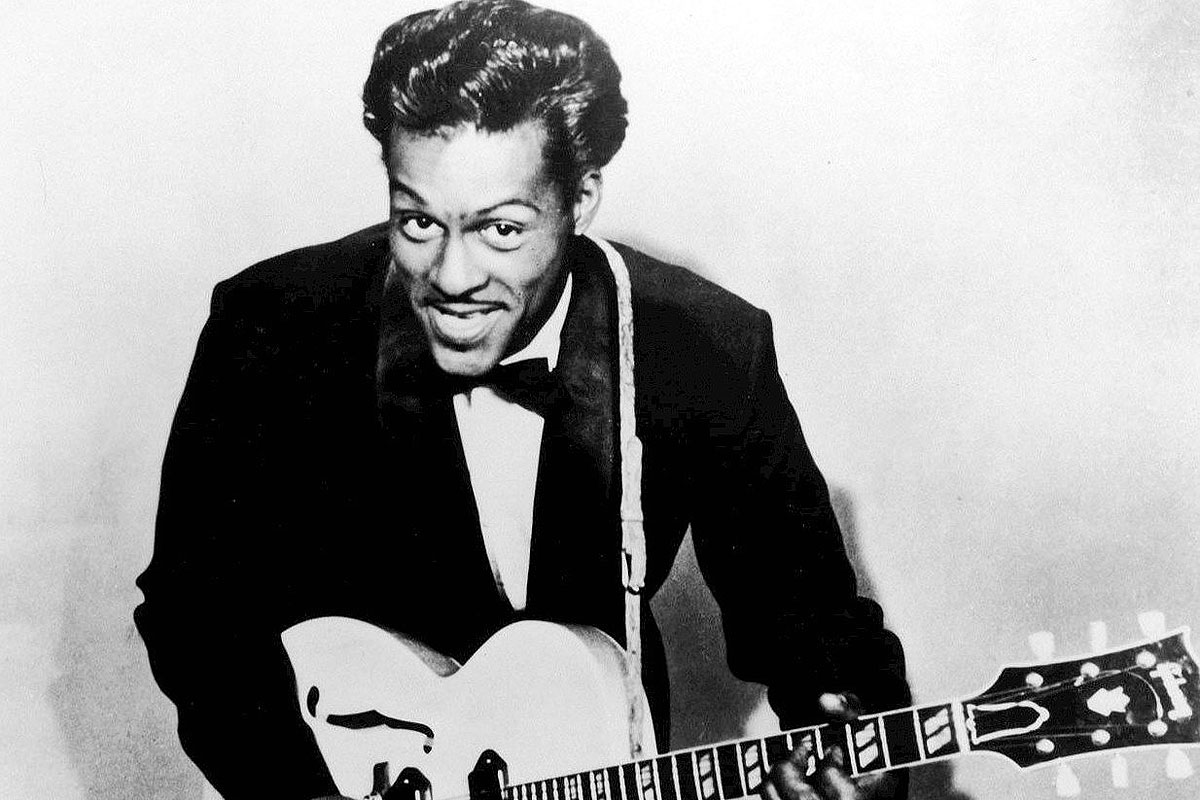
I’m probably not the only person whose life was changed by the opening riff to “Johnny B. Goode.” Even though it was recorded 23 years before I was born, ’80s kids got to experience it by proxy through Back to the Future. Greil Marcus, in his book Lipstick Traces, calls it “the most deliciously explosive opening in rock ‘n’ roll” and identifies it as an antecedent to punk. In another essay he calls it “the most inspired single passage in postwar pop music,” and it’s the sole piece of postwar American music floating around in space on NASA’s Voyager spacecraft, along with Bach, Beethoven, and Louis Armstrong.
Where did the explosion come from? It came in large part from Chicago, and a couple frustrated big-band musicians.
Chuck Berry, who died Saturday at the age of 90, was from St. Louis, and his roots start there, with the influences of “hillbilly music”—part of what the Chess brothers saw in Berry was the crossover potential of a black musician playing “white” music, much the reverse of Elvis—and Texas swing.
But what Berry really wanted to do was be a bandleader. In the book Secrets From the Masters, Berry said that he “wanted to comp chords behind a big band and play swing tunes,” but that “I was in need of a house, and a wife, and looking forward to raising a family, and even my friend Ira Harris [a local guitarist influenced by Benny Goodman’s guitarist, Charlie Christian], who could really play, he couldn’t find a job playing jazz, if you see what I mean.”
Berry was 29 when he came to Chicago, not a young man in the terms of the genre he birthed. Despite doing a three-year stint for robbery from age 18 to 21, Berry was a trained cosmetologist who owned his own home; when he showed up at Chess Records on the advice of his hero, Muddy Waters, he was a grownup with a business plan to get famous, which helped sell Leonard Chess on this unknown guitarist who showed up at his office.
Chess put him to work with two pros: the great bluesman and jack-of-all-trades Willie Dixon, who played acoustic bass on “Johnny B. Goode,” and Fred Below, possibly the most important blues drummer of all time.
Below, like Berry, had set out to be a jazz drummer; unlike Berry, he was highly trained in it. He played in a jazz band at DuSable High School, and then went to school for drumming—at the Roy C. Knapp School of Percussion at Jackson and Wabash, alma mater of Gene Krupa, led by the drummer from the city’s famous National Barn Dance program. And like Berry, he couldn’t find consistent work in the declining (and increasingly white) genre of big-band jazz, so he adapted to the popular music of the era: early R&B (Below played drums on The Moonglows’ “Sincerely”) and Chicago blues.
“What made blues fascinating with me was because it was a type of music that I wasn’t familiar with—and they didn’t teach it in school! And I don’t think they do it now. So, it’s an altogether different style. So, I had to play it in a way that it would make sense to me,” Below told Scott K. Fish in 1981.
Those big-band sounds explicitly show up in “Johnny B. Goode.” Its riff is arguably taken from “Ain’t That Just Like a Woman,” a 1946 song by Louis Jordan and His Tympany Five.
Video
Views: 1