
Introduction
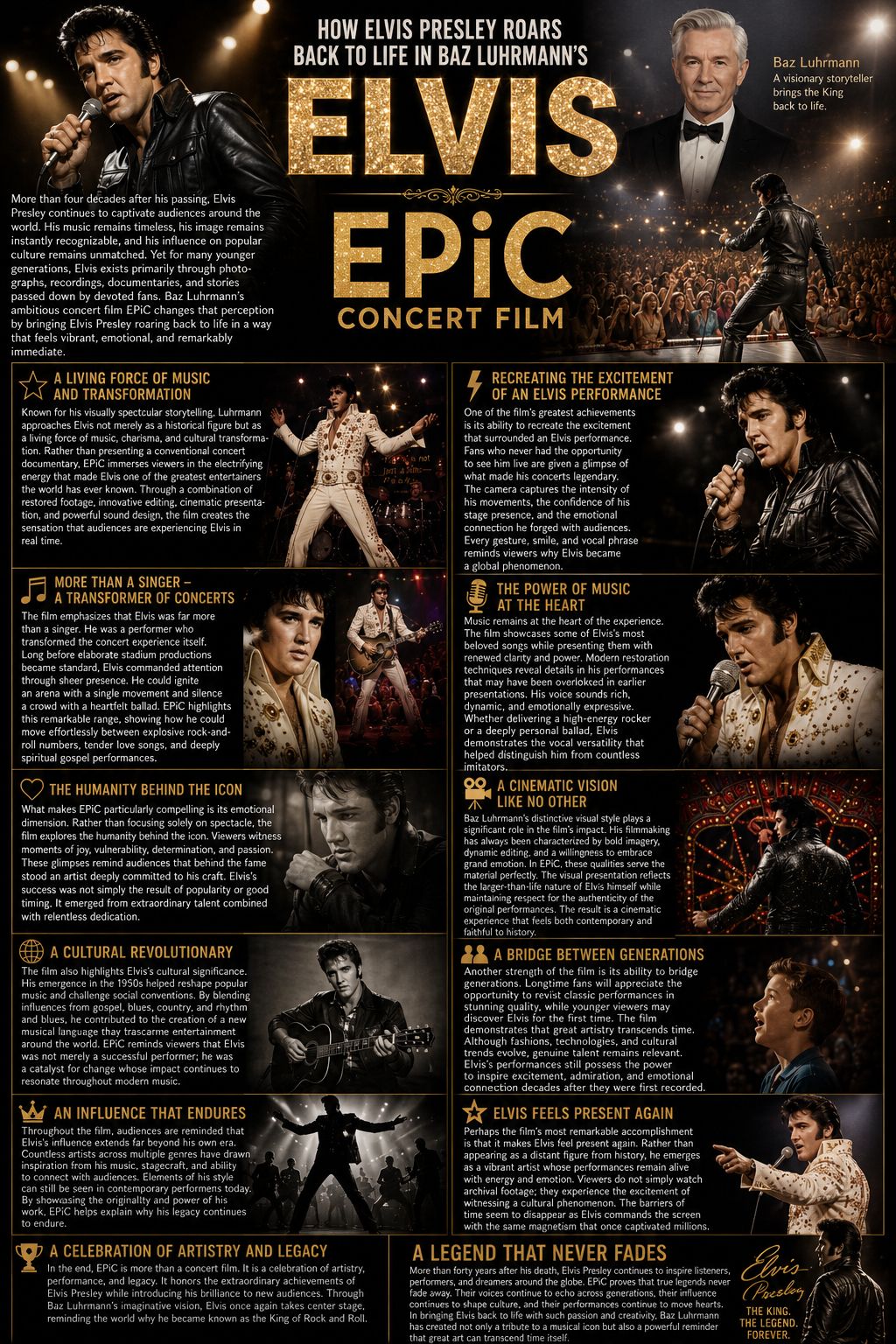
More than four decades after his passing, Elvis Presley continues to captivate audiences around the world. His music remains timeless, his image remains instantly recognizable, and his influence on popular culture remains unmatched. Yet for many younger generations, Elvis exists primarily through photographs, recordings, documentaries, and stories passed down by devoted fans. Baz Luhrmann’s ambitious concert film EPiC changes that perception by bringing Elvis Presley roaring back to life in a way that feels vibrant, emotional, and remarkably immediate.
Known for his visually spectacular storytelling, Luhrmann approaches Elvis not merely as a historical figure but as a living force of music, charisma, and cultural transformation. Rather than presenting a conventional concert documentary, EPiC immerses viewers in the electrifying energy that made Elvis one of the greatest entertainers the world has ever known. Through a combination of restored footage, innovative editing, cinematic presentation, and powerful sound design, the film creates the sensation that audiences are experiencing Elvis in real time.
One of the film’s greatest achievements is its ability to recreate the excitement that surrounded an Elvis performance. Fans who never had the opportunity to see him live are given a glimpse of what made his concerts legendary. The camera captures the intensity of his movements, the confidence of his stage presence, and the emotional connection he forged with audiences. Every gesture, smile, and vocal phrase reminds viewers why Elvis became a global phenomenon.
The film emphasizes that Elvis was far more than a singer. He was a performer who transformed the concert experience itself. Long before elaborate stadium productions became standard, Elvis commanded attention through sheer presence. He could ignite an arena with a single movement and silence a crowd with a heartfelt ballad. EPiC highlights this remarkable range, showing how he could move effortlessly between explosive rock-and-roll numbers, tender love songs, and deeply spiritual gospel performances.
Music remains at the heart of the experience. The film showcases some of Elvis’s most beloved songs while presenting them with renewed clarity and power. Modern restoration techniques reveal details in his performances that may have been overlooked in earlier presentations. His voice sounds rich, dynamic, and emotionally expressive. Whether delivering a high-energy rocker or a deeply personal ballad, Elvis demonstrates the vocal versatility that helped distinguish him from countless imitators.
What makes EPiC particularly compelling is its emotional dimension. Rather than focusing solely on spectacle, the film explores the humanity behind the icon. Viewers witness moments of joy, vulnerability, determination, and passion. These glimpses remind audiences that behind the fame stood an artist deeply committed to his craft. Elvis’s success was not simply the result of popularity or good timing. It emerged from extraordinary talent combined with relentless dedication.
Baz Luhrmann’s distinctive visual style plays a significant role in the film’s impact. His filmmaking has always been characterized by bold imagery, dynamic editing, and a willingness to embrace grand emotion. In EPiC, these qualities serve the material perfectly. The visual presentation reflects the larger-than-life nature of Elvis himself while maintaining respect for the authenticity of the original performances. The result is a cinematic experience that feels both contemporary and faithful to history.
The film also highlights Elvis’s cultural significance. His emergence in the 1950s helped reshape popular music and challenge social conventions. By blending influences from gospel, blues, country, and rhythm and blues, he contributed to the creation of a new musical language that transformed entertainment around the world. EPiC reminds viewers that Elvis was not merely a successful performer; he was a catalyst for change whose impact continues to resonate throughout modern music.
Another strength of the film is its ability to bridge generations. Longtime fans will appreciate the opportunity to revisit classic performances in stunning quality, while younger viewers may discover Elvis for the first time. The film demonstrates that great artistry transcends time. Although fashions, technologies, and cultural trends evolve, genuine talent remains relevant. Elvis’s performances still possess the power to inspire excitement, admiration, and emotional connection decades after they were first recorded.
Throughout the film, audiences are reminded that Elvis’s influence extends far beyond his own era. Countless artists across multiple genres have drawn inspiration from his music, stagecraft, and ability to connect with audiences. Elements of his style can still be seen in contemporary performers today. By showcasing the originality and power of his work, EPiC helps explain why his legacy continues to endure.
Perhaps the film’s most remarkable accomplishment is that it makes Elvis feel present again. Rather than appearing as a distant figure from history, he emerges as a vibrant artist whose performances remain alive with energy and emotion. Viewers do not simply watch archival footage; they experience the excitement of witnessing a cultural phenomenon. The barriers of time seem to disappear as Elvis commands the screen with the same magnetism that once captivated millions.
In the end, EPiC is more than a concert film. It is a celebration of artistry, performance, and legacy. It honors the extraordinary achievements of Elvis Presley while introducing his brilliance to new audiences. Through Baz Luhrmann’s imaginative vision, Elvis once again takes center stage, reminding the world why he became known as the King of Rock and Roll.
More than forty years after his death, Elvis Presley continues to inspire listeners, performers, and dreamers around the globe. EPiC proves that true legends never fade away. Their voices continue to echo across generations, their influence continues to shape culture, and their performances continue to move hearts. In bringing Elvis back to life with such passion and creativity, Baz Luhrmann has created not only a tribute to a musical icon but also a powerful reminder that great art can transcend time itself.