
Introduction
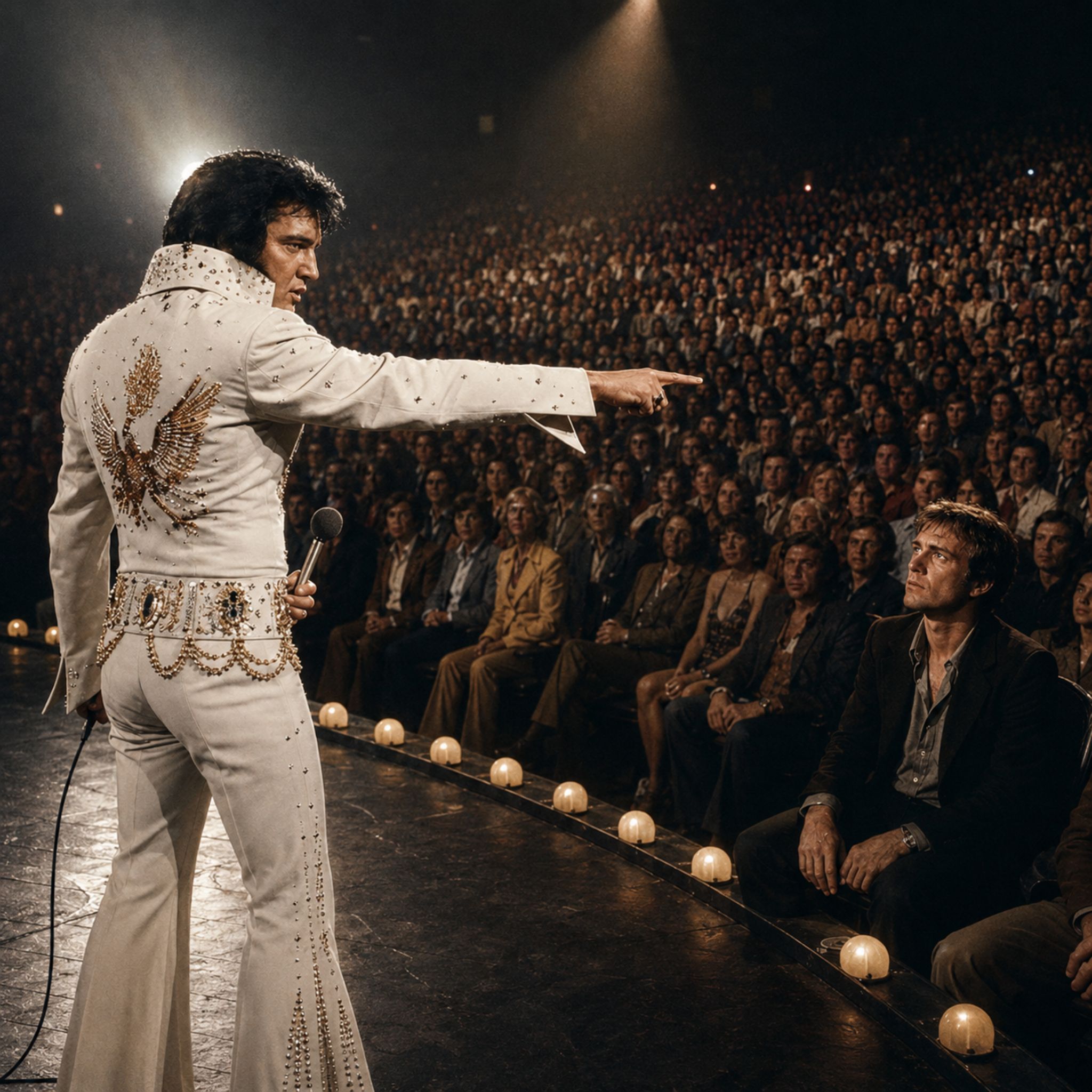
Some stories about Elvis Presley begin with thunderous applause, flashing lights, and the unmistakable electricity of a Las Vegas stage. But the most powerful stories are not always the loudest ones. Sometimes, they begin in silence. They begin when a performer stops singing, looks into the crowd, and sees not thousands of faces, but one wounded heart. That is the emotional weight behind this unforgettable story from On February 14, 1973, inside the Las Vegas Hilton, when Elvis Presley was said to have paused a performance before 2,000 people and turned an ordinary concert into something far deeper than entertainment.
Then he looked toward one man in the audience and spoke softly: “I can see you’re carrying something heavy tonight.”
Those words cut through everything. They were not show business words. They were not part of a planned routine. They sounded like the words of one human being recognizing the sorrow of another. The man was Robert Dillon, a high school music teacher from Arizona, and according to the story, he had lost his 16-year-old son only four months earlier. In that moment, the concert disappeared. There was no superstar. No spotlight. No separation between stage and seat. There was only grief being noticed.
For any parent, the loss of a child is a pain that language can barely hold. It changes the shape of every ordinary day. It follows a person into rooms full of laughter, into holidays, into songs, into quiet mornings. A grieving father may sit among thousands and still feel completely alone. But that night, in a room built for performance, Elvis seemed to sense what applause could not cover.
The beauty of the moment is not that Elvis had all the answers. No artist, no matter how beloved, can erase such sorrow. What mattered was that he stopped long enough to acknowledge it. He invited Robert backstage, listened to his story, and offered the kind of comfort that cannot be measured by fame. Sometimes the most meaningful gift is not advice. It is presence. It is a hand on the shoulder. It is the quiet message: your pain has been seen.
This is why the story feels so connected to the deepest part of Elvis’s legacy. His greatest power was never only in his voice, though that voice was unforgettable. It was in the way he made people feel less alone. Whether he was singing gospel, a tender ballad, or a song filled with longing, Elvis had a rare ability to turn public performance into private emotion. He could make a crowd feel like a room, and a song feel like a prayer.
For older and thoughtful readers, this moment carries a special meaning. It reminds us that music is not only entertainment. Music becomes a shelter. It becomes a bridge between people who may never meet but somehow understand one another through melody, memory, and sorrow. When words fail, music can still enter the places where grief sits quietly. That is why What followed in the years after became more than a memory. It became a reminder that compassion can outlive the moment in which it is given.